My Dishwasher Died. I Was About to Spend $2,000. Instead I Spent $73.
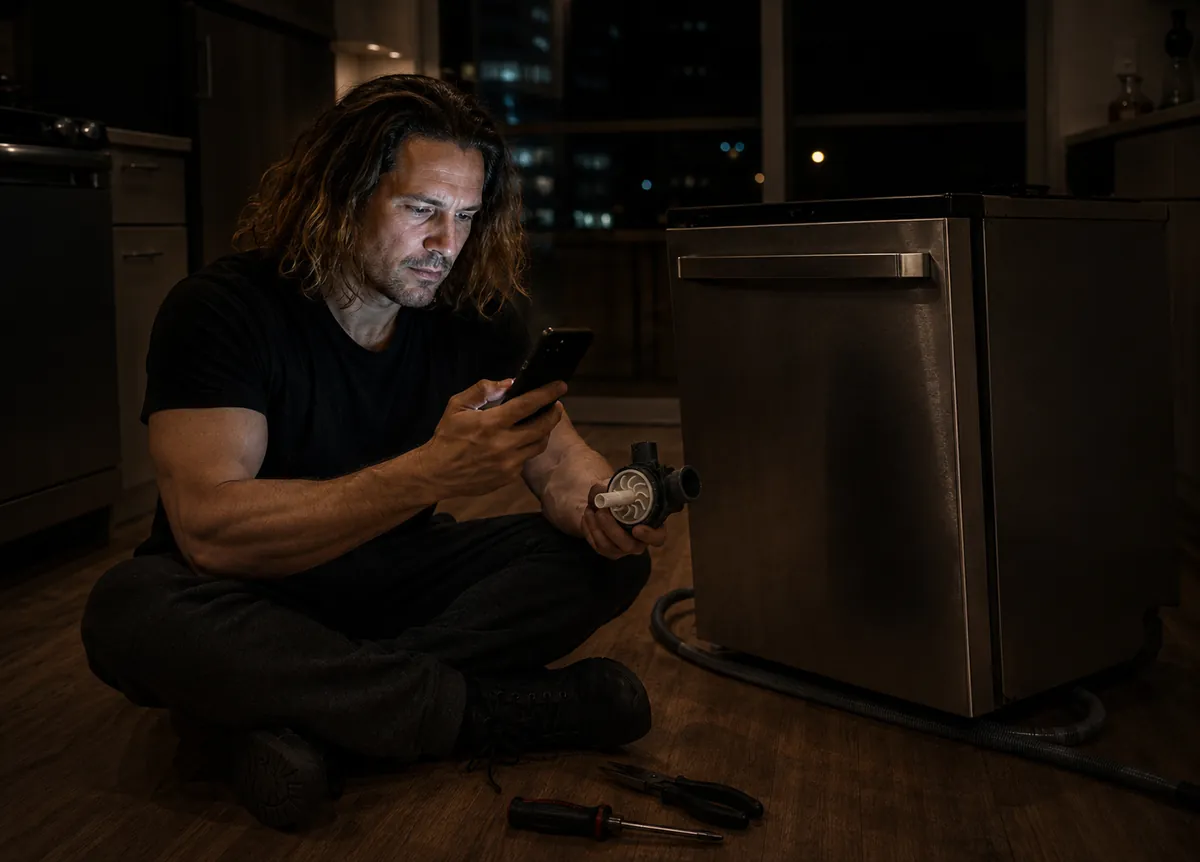
I was on my kitchen floor, a dishwasher tipped onto its side in front of me, a plastic part in one hand and my phone in the other, when I stopped and thought: how exactly did I get here.
Let me back up, because I promise this is not one of those posts. You know the ones. A guy plants tomatoes over the weekend and by Monday it’s a LinkedIn parable about nurturing your sales pipeline. A guy plays catch with his kid and suddenly it’s a meditation on customer feedback loops. I find that stuff insufferable, and I’m not going to do it to you. There is no metaphor here. I actually fixed a dishwasher. The reason I could is the part worth your time, because I think most of you are using the same tool I used for a tenth of what it can do.
The part that still surprises me: I am not a repair guy. I have never been a repair guy.
The setup: I was done
Some context on my state of mind, because it matters.
This was my second GE dishwasher to die at almost exactly four years. The one before it, a GE Cafe, also lasted four years. This one, a GE Profile, made it to four and then stopped cleaning. Both of these were roughly $2,000 machines. Not budget units. I had, in my head, a reasonable expectation that a $2,000 appliance lasts ten to fifteen years, and instead I was on a four-year replacement treadmill with a brand I’d stopped trusting.
And it wasn’t just the machines. Over the last few years I’d called in repair techs three separate times for dishwasher problems. Every single visit followed the same script: the machine hadn’t failed, we had. We weren’t pre-rinsing enough. The kids were scraping too little off their plates. They told me they’d pulled out hoses packed with food scraps and replaced a line, or a motor, or some part I couldn’t see. Two or three visits each time, a few hundred dollars, and at the end of all of it the machine still didn’t work and I bought a new one anyway. I’m sure there are excellent appliance techs out there. I just kept paying for the other kind.
So by the time this GE Profile started leaving grit on everything, I was done. Done with the brand, done with the repair industry, done with the whole cycle. My plan was to buy a Bosch or a Miele, something with actual longevity reviews, and never think about GE again.
Being that fed up makes you reckless in a useful way, though. Before I dropped another two grand, I figured I had nothing to lose by poking at the dead one myself. If I broke it further, who cares. It was going in the bin regardless. That “nothing to lose” feeling turned out to be what unlocked the whole thing. Brave had nothing to do with it. I was cornered, and cornered is a surprisingly good place to try something new.
So I opened up a chat with Claude and started describing what was wrong.
A note on naming names: I use a handful of different AIs day to day. I’m calling out Claude here because it’s the one I used for this, and I don’t know whether you’d have the same experience with every model. This is a report from one repair, not a product comparison.
Act one, months earlier: the small win that earned my trust
Actually, I need to rewind further, because this story has two acts and the first one is why the second one happened.
A few months before all this, the same dishwasher had started cleaning poorly. Not dead, just weak. I described the symptoms to Claude and we landed on a theory: clogged spray arms. I pulled them, cleaned them out, put them back, and it worked. Dishes came out clean again.
At the time I thought that was the whole story. Looking back, I suspect the part that actually killed the machine months later was already starting to fail even then, and the weak water pressure plus a bit of clogging combined to cause that first symptom. Cleaning the arms fixed half the problem and bought me a few months. But I didn’t know that yet.
What that small first win did mattered more than I realized at the time. It taught me the thing could actually help with a physical, real-world problem, not just draft an email. So when the machine came back worse, I didn’t reach for the phone to call a tech I didn’t trust. I went back to the chat. The little success is what earned the big attempt. I suspect that’s how most people will actually come to trust these tools: a small thing works, then a slightly bigger one, and the ambition grows with the track record.
Act two: the actual diagnosis
The second time, it wasn’t weak. It was dead.
Water was filling. It was hot. The detergent tab was dissolving. The machine was draining fine at the end. And yet everything came out steam-damp instead of spray-wet, with dirt still sitting on the door after a full cycle.
What followed was a long back-and-forth across days and test cycles, and it was more collaborative than I expected. I’d report what I was seeing, it would tell me what that ruled in or out and what to check next. We went through it methodically. Spray arms, clean and spinning free. Filter, clean. Detergent dispenser, opening on schedule. Water level, correct. Drain, working.
The key observation, the one that cracked it, came when I ran a cycle, waited until the main wash, and opened the door to watch. The lower spray arm was completely still. Dead. But I could hear water sloshing and moving inside the machine. The pump was clearly running and pushing water somewhere, it just wasn’t driving the arm.
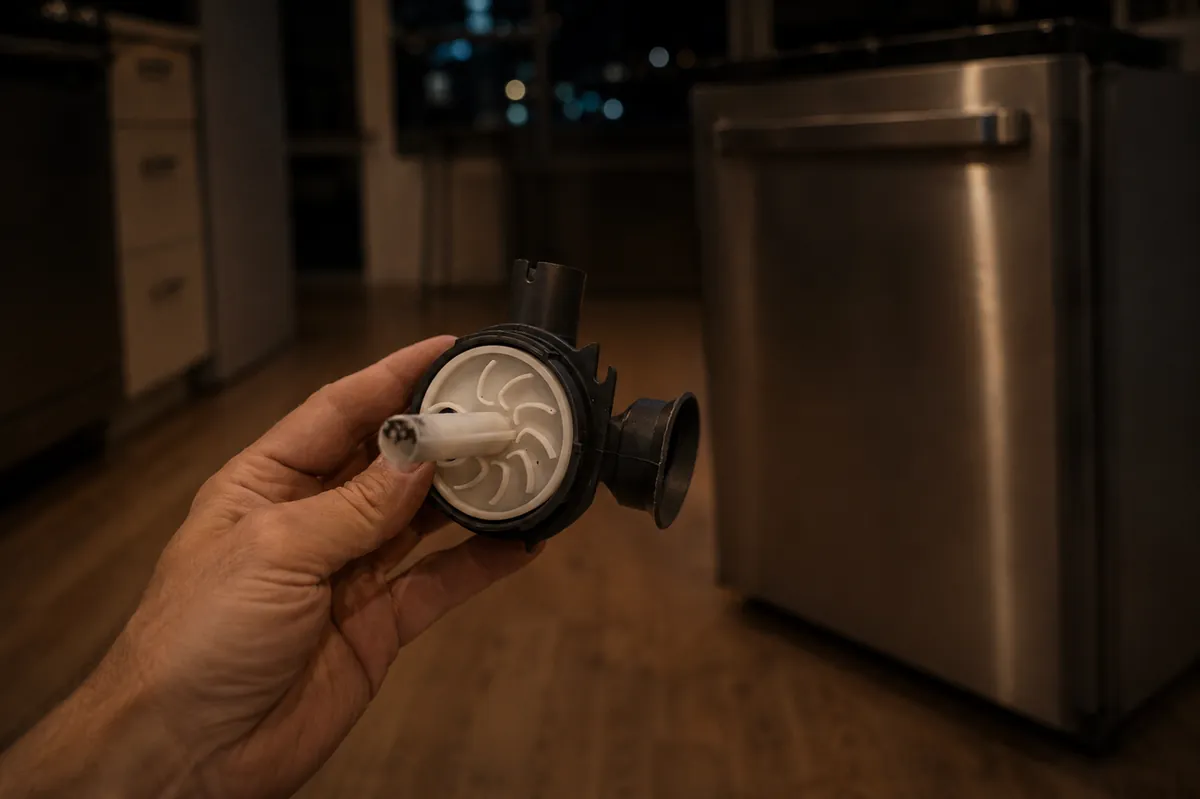
That single observation is what pointed us at the culprit: a small part called the diverter, the thing that switches water between the different spray arms. When it fails, the pump runs, water moves, but it never gets sent where it needs to go. Dead lower arm, water noise everywhere else, soap left sitting un-rinsed in the bottom. It fit every symptom exactly.
I ordered the part off Amazon for about $73. A four-year-old machine is easily worth a $73 repair instead of a $2,000 replacement, so this was, suddenly, a very different decision than the one I’d been about to make.
The detour, which is the actual point
This next part is the one I really want you to pay attention to, because it’s the honest half of the story and the half that most AI cheerleading leaves out.
When it came time to actually get at the diverter, Claude told me, confidently and in clear step-by-step detail, what the job required: shut off the power and water, disconnect the supply line and the drain hose, wrestle the whole machine out of the cabinet, and lay it down to reach the part from underneath.
So that’s what I did. All of it. Power off, water off, plumbing disconnected, a large appliance walked across my kitchen floor and tipped onto its side. Then, with the machine lying there, I asked for the detailed steps to open up the bottom assembly, and something interesting happened. Claude went and actually looked up the repair procedure for my specific model, came back, and cheerfully informed me that this particular part releases from inside the tub. Take the spray arm off, unthread two screws, and it’s right there. I had not needed to disconnect anything. I had not needed to move the machine at all.
I was, to put it mildly, annoyed.
And notice how the mistake worked. The instructions weren’t gibberish I could laugh off. They were plausible, specific, and delivered with the same tone of authority as all the correct advice that came before them. That’s what makes this kind of error dangerous. When a tool is right most of the time in a calm, confident voice, the errors arrive in that same calm, confident voice, and nothing flags them for you. What saved me wasn’t luck or instinct. It was going back and demanding the exact steps for my exact machine before cutting any deeper, which forced a real answer where there had been a generic one. Confirm before you follow blindly. I learned that one on my kitchen floor.
To its credit, once pinned down, it delivered: the precise sequence of steps, in order, and a video of the procedure so I could watch the motion before touching anything. Both were right. I stood the machine back up, went in through the tub, swapped the part, and it worked. Water dripping from the upper rack during the pre-wash, the arm spinning hard, dishes clean. First load out of it, I felt like I’d gotten away with something.
There was one bonus finding from having been inside the machine myself, filter out, sump open, a finger down both ducts. Zero food buildup. Anywhere. The story I’d been sold for years was that my family was killing these machines. We didn’t pre-rinse enough, the kids left too much on their plates, hoses were supposedly coming out packed with food scraps. I clean the filter monthly, for the record. And I’ve since learned that the enzymes in modern detergents exist specifically to break down the food residue I was being lectured about. Now I’d finally seen the inside of one of my machines with my own eyes, and it was spotless. A $73 part had simply worn out, four years into the life of a $2,000 appliance. I’ll let you draw your own conclusions about the diagnostic rigor of a trade built on minimum call-out charges and customers who have no way to check the work.
So what does this actually tell you
I want to be careful here, because it would be easy to draw the wrong lesson in either direction.
The wrong boosterish lesson is “AI can fix anything now, fire your repairman.” No. It confidently tried to send me tipping a dishwasher onto its back for no reason.
The wrong cynical lesson is “it hallucinated, so it’s useless.” Also no. Without it, I would never have attempted this. I want to be precise about that word. Not couldn’t. Wouldn’t. The information was technically out there on the internet somewhere, in scattered forum posts and parts diagrams and a couple of repair videos for adjacent models. But a Google search hands you ten tabs and leaves you to become your own general contractor, synthesizing it all alone, and somewhere around the third dead end most of us give up and call someone. What was different this time was having something that held the entire diagnostic thread, adapted as I fed it real observations, and stayed with me from “the dishes are damp” all the way to “here’s the exact part number.” It lowered the activation energy enough that I was willing to start. That’s the actual magic, and it’s quieter and more interesting than “it knows everything.”
If I had to pull out what made it work, it’s three things, and I offer them as observations rather than a framework, because I distrust frameworks that arrive too neatly.
It worked because the diagnosis was iterative, not a single lucky guess. We eliminated causes one at a time over two acts and several weeks. Nobody nailed it on the first try, and that’s fine, because the process was built to narrow.
It worked because the quality of what I put in determined the quality of what I got out. Every good turn came from an accurate observation on my end. The dead arm, the sloshing water, the soap left in the sump. If I’d reported those things carelessly or wrong, we’d have gone confidently down the wrong path together and stayed there. Garbage in, garbage out, same as it ever was.
And it worked because I stayed the judge. The detour is the whole proof of that. The tool is a phenomenal thinking partner and a terrible thing to follow blindly, and the human staying in the loop at the risky moments, at the seams, is what carries the weight of the whole arrangement.
I was on the panel at a roundtable of business leaders recently, and when the subject of AI came up the answers clustered into three: we use it as a junior assistant, we use it to help write things, or we haven’t really started and we know we need to. That’s it. That’s the range for most people right now. Write my emails, clean up my copy, summarize this document.
I’m not knocking that. But I fixed a machine myself, for $73, standing on my kitchen floor with a part in my hand, after years of paying professionals hundreds of dollars to not fix its predecessors. And the tool that got me there is the same one most people are using to punch up their LinkedIn posts. Promote it past junior assistant. Just don’t make it CEO yet. You still have to be the one who decides when to stop and say, wait, this doesn’t feel right.
The dishes are clean, by the way. And I never did have to call anyone.